How to Trade Crypto: A Step-by-Step Guide
To trade crypto, open an account on a reputable exchange, learn spot trading before leverage, and write a plan for every trade with an entry, a stop-loss and a target. Size each position so a stopped-out trade costs a small, fixed share of your account, then record and review every result.



How to Trade Crypto in 7 Steps
This is the order that keeps beginners out of the most expensive mistakes. Each step takes minutes to learn and a few weeks of practice to make a habit.
Learn the Basics Before You Fund an Account
Know the difference between spot and futures, a market order and a limit order, and what a stop-loss does. Paper trade a few setups first.
Pick an Exchange and Lock Down the Account
Use a well-known exchange that serves your country, turn on two-factor authentication, and never share your seed phrase, keys or login with anyone.
Write a Simple Trading Plan
What you trade, which timeframe, what makes you enter, where the stop goes and where you take profit. If it isn't written down, it isn't a plan.
Size Every Trade by Its Stop
Choose a fixed share of the account to risk, often 1% or less, and let the distance to your stop decide the position size.
Place the Order With the Stop Attached
Enter with a limit or market order and set the stop-loss at the same time, so the plan is in place before the price moves.
Take Profit in Stages
Close part of the position at each target. Locking in some profit early makes it easier to hold the rest without fear.
Record and Review Every Trade
Log the entry, stop, size, result and why you took it. Review the losers as carefully as the winners, once a week.
Spot vs. Futures: Know What You Are Buying
On spot, you buy the coin itself. If Bitcoin falls 20%, your position is worth 20% less, but you still hold it and nobody can close it for you.
With futures and other leveraged products you post margin and control a bigger position. Gains and losses grow with the leverage, and if the price moves far enough against you, the exchange closes the position at the liquidation price. The rule that matters: your stop has to sit before your liquidation price, never after it.
Take the same long at $80,000 with a stop at $76,800. At 5x leverage the estimated liquidation is around $64,400, far beyond the stop, so the stop gets you out first. Push the leverage to 25x and the estimate rises to about $77,200, above your stop, so the exchange can close you before your plan does. The leverage and liquidation calculator shows the highest leverage that keeps liquidation beyond your stop, which is 22x for this trade.
Classic estimate: entry x (1 - 1/leverage + 0.5% maintenance margin). Exchanges use tiered margin, so check the price your exchange shows.
The Orders You Will Use Most
Every exchange names them a little differently, but these four do almost all the work.
| Order | What It Does | When to Use It |
|---|---|---|
| Market | Buys or sells right away at the best price available. | When getting in or out now matters more than the exact price. |
| Limit | Buys or sells only at your price or better. It may never fill. | Entries at a planned level, and most take-profits. |
| Stop-Loss | Becomes an order to close the trade once price reaches your stop. | On every trade, placed when you enter. |
| Take-Profit | Closes all or part of the trade at your target. | At each target in your plan, so profits are taken without you watching. |
Fees matter more than most beginners expect. Every order pays a fee to the exchange, and perpetual futures positions can also pay or receive funding. The worked example below assumes 0.05% per side; check your own exchange's fee page and plug the real number into the calculator.
Size Your First Trade Like This
Position sizing is the step most new traders skip, and it's the one that keeps a bad week from becoming a blown account.
Start with the most you're willing to lose on this one trade. With a $10,000 account and 1% risk, that's $100. The stop is 4% away, so the position is $100 divided by the stop distance plus fees, which works out to 0.03050 BTC, about $2,440. Leverage doesn't change that number. It only changes how much margin you post and where liquidation sits.
Lose ten of these in a row and the account is down about 9.6%, not wiped out. That is the point. Run your own numbers in the position size calculator before every trade until the math is automatic.
- Account
- $10,000
- Risk per trade
- 1% = $100
- Entry
- $80,000
- Stop
- $76,800
- Stop distance
- 4.00%
- Position size
- 0.03050 BTC
- Position value
- $2,440.21
- Loss if the stop hits, fees included
- $100.00
- Target 1, close 50%
- $84,800
- Target 2, close 30%
- $89,600
- Target 3, close 20%
- $96,000
- Reward if all three hit, after fees
- $256.09
- Risk to reward
- 1 : 2.56
Where to Learn Faster
Reading the chart is a skill, and it comes faster with feedback. Start with support and resistance, then add one indicator at a time, such as the RSI or the VWAP.
A trading community can shorten the learning curve if it explains its calls instead of only posting them. In Data's Alpha Circle, every call comes with an entry, targets and a stop, every take-profit and stop-loss is published each week on the results page, and members can ask DataBot to walk them through an open call at any hour. New traders can start with the beginners guide and a free week, with no card and nothing to cancel, if they haven't been a member before.
Taxes are part of trading too. In the US, the IRS treats digital assets as property, and you have to report digital asset transactions whether or not they made a gain (IRS). Keep your trade log; it doubles as your tax record.
Beginner Mistakes to Skip
- Trading money you can't afford to lose. Crypto can drop fast and stay down.
- Leverage before you understand liquidation. Learn on spot first.
- Buying because a group said so. Groups that promise profits or show only wins are a red flag. The signals scam check lists ten more.
- Revenge trading. Taking a bigger trade to win back a loss is how small losses turn into large ones.
- Sharing your keys. No real exchange, group or support agent needs your seed phrase. If yours leaked, follow the crypto hack checklist.
Questions People Ask
Short answers to what people search for most, in plain words.
How much money do I need to start trading crypto?
Most exchanges let you start with a small amount. What matters more is that it is money you can afford to lose and that each trade risks only a small, fixed share of it, often 1% or less.
Is crypto trading good for beginners?
It can be if you learn before you risk money. Start with spot trades, size every position by its stop, and keep a record of every trade. Avoid leverage until you understand how liquidation works.
What is the difference between trading and investing in crypto?
Investing usually means buying and holding for months or years. Trading means opening and closing positions over hours, days or weeks, with a planned entry, stop and target for each one.
Can you lose more than you put in?
On spot you can lose what you paid for the coin. With leverage, a position can be liquidated and you can lose the margin you posted, quickly. Terms vary by exchange and product, so read your exchange's rules before using leverage.
Do I have to pay taxes on crypto trades?
In the US, the IRS treats digital assets as property and requires you to report digital asset transactions whether or not they made a gain. Rules differ by country, so check with a tax professional where you live.
Keep Reading
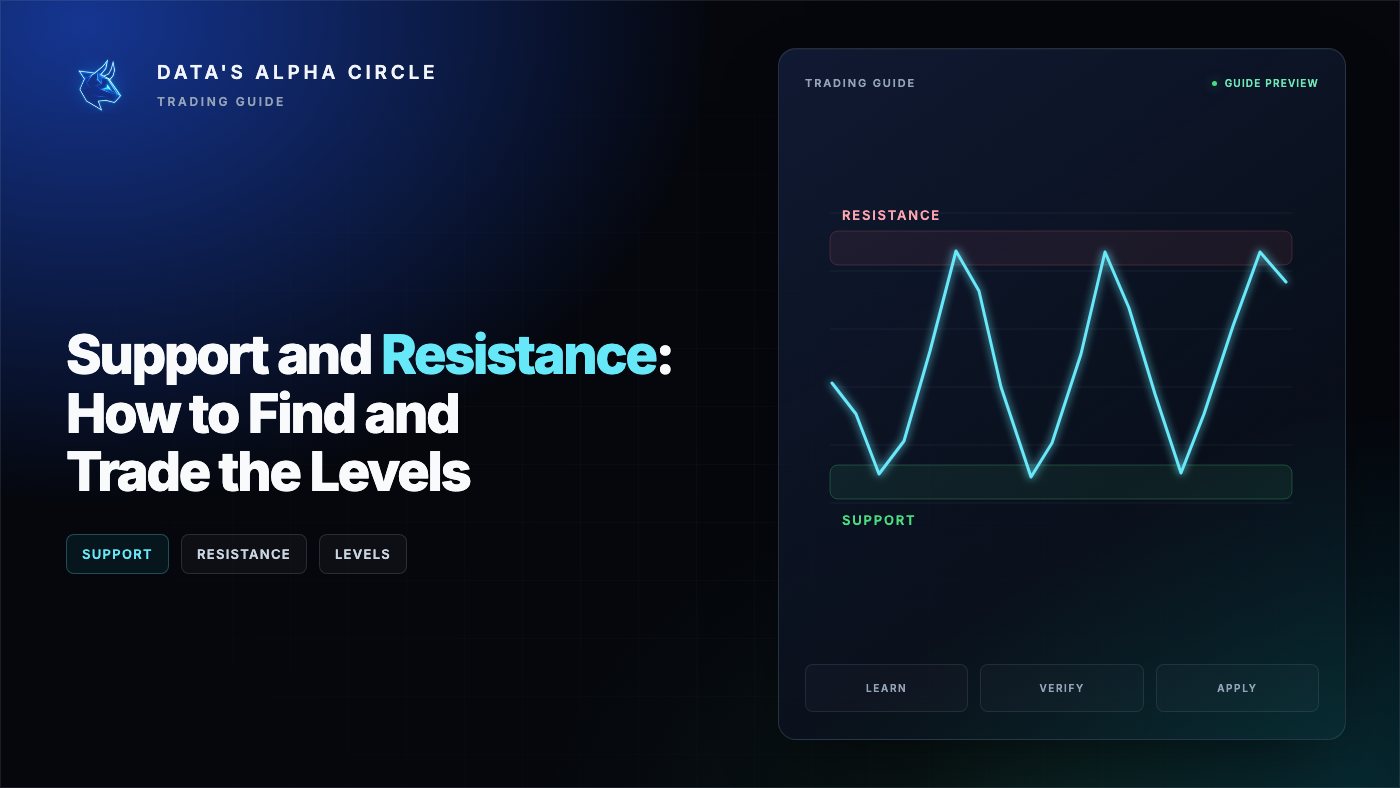
Support and Resistance
Find the levels, then trade the bounce or the breakout.
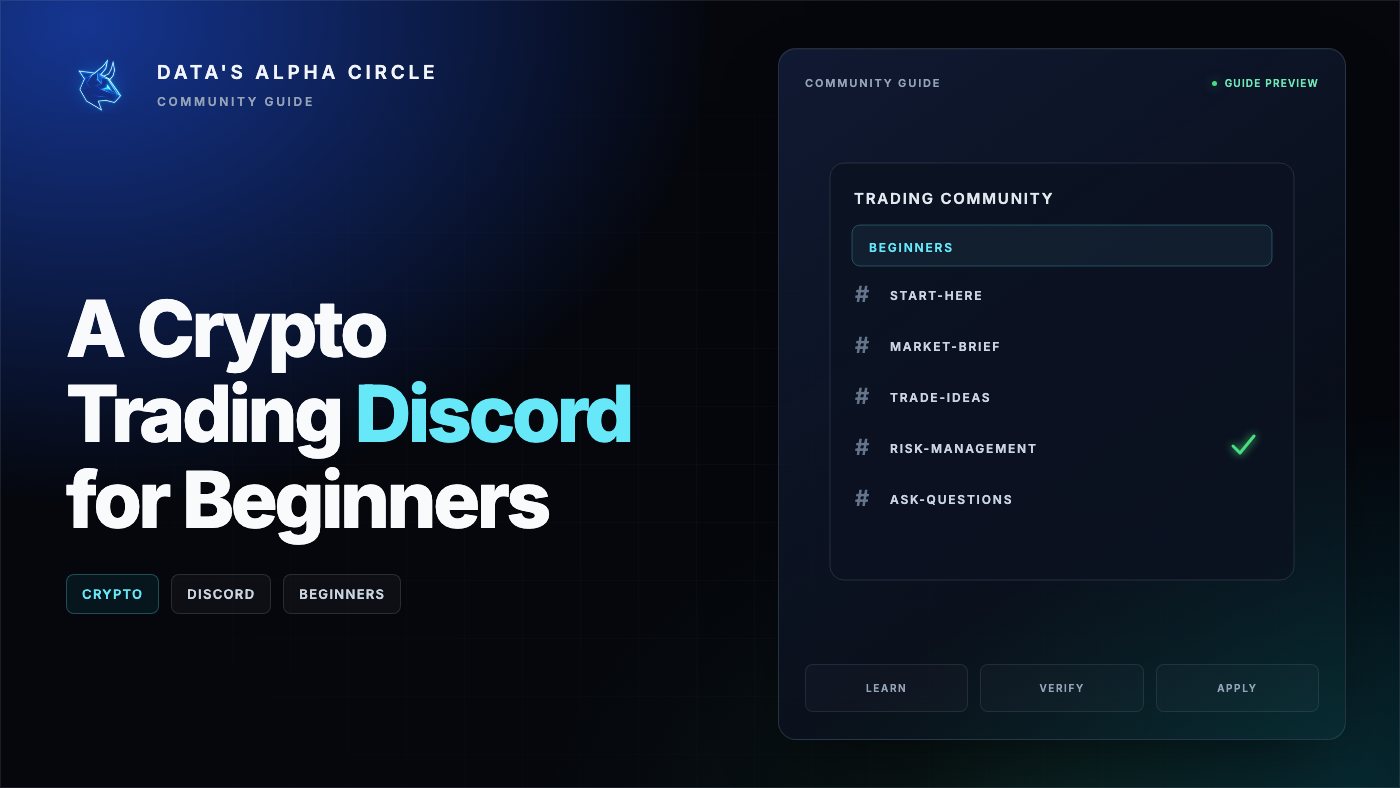
A Crypto Trading Discord for Beginners
How a new trader can learn the skill without copying blindly.
Best Crypto Signals Providers
How to judge any signals group before you pay.
RSI Indicator
The most popular momentum oscillator, explained with real math.
Sources
- IRS: Digital assets
- FTC: What to know about cryptocurrency and scams
- Sizing and liquidation math: the position size calculator and the leverage and liquidation calculator.
Every source was opened and checked on Nov 3, 2026.

Free. CryptoData's 19-day trading course and his market brief by e-mail on Mondays, Wednesdays and Fridays, plus the week's results and Data's Alpha Circle news. Unsubscribe anytime in one click. Privacy
Bring Your Questions. Build Your Process
Join on Whop, connect your Discord and start in the start-here channel. The calls, courses and DataBot are inside.
7 days inside, no card, nothing to cancel. For anyone who hasn't been a member before.
Pay by Card or Crypto